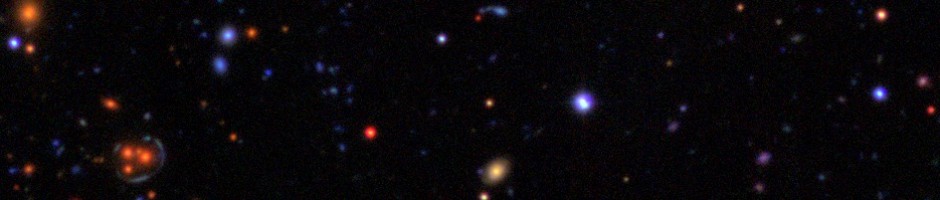
Space Warps helps to find 497 spectacular lenses in Euclid data
by Phil Holloway
Thanks to your incredible efforts, we are delighted to have found 497 strong lens candidates in Euclid Q1 data. Over the course of the project we had more than 800,000 classifications from over 1000 wonderful volunteers, and the results are a testament to your hard work. As part of the lens search, we developed the Strong Lens Discovery Engine, a pipeline to search for lenses in Euclid data, of which Space Warps was an integral part.
We found a whole range of lens candidates – a collage of our favourites is below, with a whole range of lens configurations. We also found 4 double-source-plane lenses! These are incredibly rare systems where the lensing galaxy deflects light from two different background galaxies, forming double rings/arcs.
We have temporarily removed these images while the Euclid Refine project is live
Credit: ESA/Euclid/Euclid Consortium/NASA, M. Walmsley, T. Li, N. Lines, and Euclid SL SWG
We have temporarily removed these images while the Euclid Refine project is live
Credit: Euclid Collaboration: Walmsley et al (2025)
As part of the Strong Lens Discovery Engine we used multiple machine learning algorithms (including ‘Zoobot’ trained using zooniverse classifications in Galaxy Zoo) to do an initial sift of the data which the Space Warps volunteers inspected to find the most likely lens candidates. This machine + volunteer partnership will be crucial with the much larger data releases coming soon from the Euclid survey. We also used Euclid’s incredible resolution to produce precise models of all the lens candidates and will continue to analyse these fascinating lenses for many months and years to come!
You can read the full results in the 5 science papers released today:
B: Lens search around massive galaxies,
C: Finding lenses with machine learning,
D: Double-source-plane lenses,
E: Lens classification combining machine learning and Space Warps.
Thank you again for your incredible hard work in finding these amazing lenses – we couldn’t have done it without you! Keep an eye out for future Space Warps projects – this initial data release was only 0.4% of the sky area of the full survey, so there will be many many more exciting lenses to find soon!
Stay tuned!
Phil and the Space Warps Team
Phil Holloway is a final year PhD student in the Department of Physics at Oxford and has done amazing work through his time with us including on Space Warps! We’re so thankful to Phil and to you all for making these results possible. Phil, Anu & Aprajita (Space Warps co-leads).
Space Warps finds new lenses in the Dark Energy Survey
A while ago, we ran a project lead by Jimena Gonzalez Lozano ran the FIRST machine learning+citizen inspection system to find strong gravitational lenses searching all of galaxies in the Dark Energy Survey.
The machine learning model makes use of the transformer encoder, which is based on the attention mechanism. Transformers were originally designed for natural language processing tasks. However, they can also be employed in image-processing tasks — like facial recognition in photographs — that in our case score images on their likelihood of being a gravitational lens. All of you then helped to sift through these likely candidates producing amazing results! A few words from Jimena…
Thank You for Helping Us Discover Hundreds of Strong Lenses!
Thanks to the incredible efforts of hundreds of volunteers who classified over 20,000 images, we have identified hundreds of strong gravitational lenses! After carefully reviewing the highest-scored images, we classified the final candidates into three categories based on confidence:
• 149 “definite” lenses
• 516 “probable” lenses
• 663 “could-be” lenses
You can find the full results in our publication available on arXiv, where Figures 12–15 showcase examples of candidates from each confidence category. Below is an image highlighting some of the high-confidence strong lenses that had not been identified before!

This project holds the record for finding the most strong lenses in the Dark Energy Survey. Additionally, we found that our machine learning methodology produces significantly fewer false positives (incorrect lens classifications) than previous techniques. This makes it a powerful tool for the next generation of astronomical surveys, where we will be dealing with massive amounts of data.
Importantly, even the images classified as not being lenses are valuable! They can be used to train future machine learning models, helping refine and improve their accuracy.
Finally, here is a collage showcasing the incredible diversity of strong lenses discovered in this project—featuring a variety of shapes, sizes, and colors.
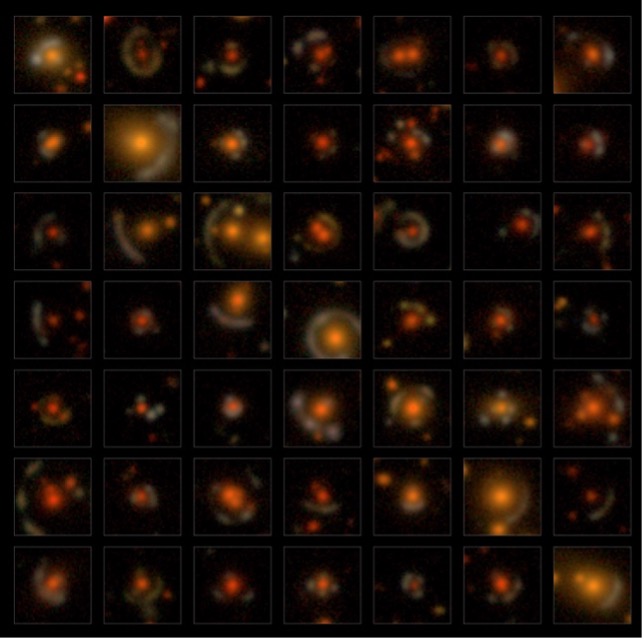
A collage of strong lenses that you helped to identify! This image was the winning entry in the UW-Madison 2023 Cool Science Image Contest.
Thank you once again for your time and dedication. Your contributions have made a real impact on the search for these rare cosmic phenomena!
Jimena and the Space Warps Team
 Space Warps