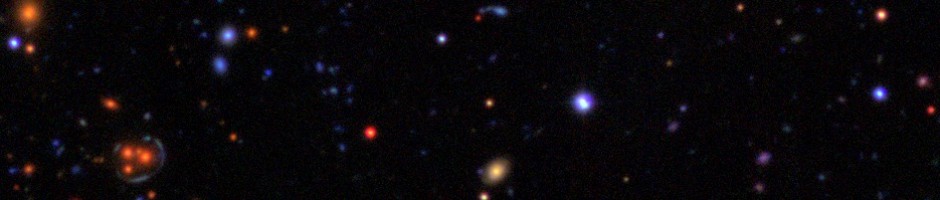
WOW: A million classifications!!
After just two weeks, we have surpassed an incredible 1 million classifications on the new ESA Euclid data! Many congratulations to all of the Space community on reaching this milestone! We have been blown away by your amazing contributions – a huge thank you to each and every one of you! In this blog post, Phil Holloway shares some of his favourites from the fantastic systems the Space Warps community has found so far.
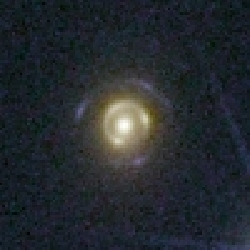
First up is a double-source plane lens (ID: 119647449), where two different galaxies, at different distances from us, are lensed by the same foreground galaxy. Double-source plane systems are very rare because they require all three galaxies (the lens, and two sources) to be almost perfectly aligned. This system shows two rings around the central lens, and is reminiscent of the Jackpot lens in its almost circular nature. Such a clear double-source-plane lens will no doubt be studied for many years to come.
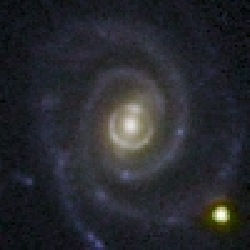
The second system is a face-on spiral lens (ID: 119679277). Most lens galaxies are elliptical and are typically made up of old stars. Occasionally, spiral galaxies can act as lenses, since they have the most massive and older stars in their central regions, though when they do they are usually seen edge-on since this maximises the amount of mass along our line-of-sight which makes lensing more likely. Face-on spiral lenses, such as shown below, are practically unheard of! This lens, alongside a beautiful spiral galaxy complete with bright blue star-forming clumps, is a really fantastic find.
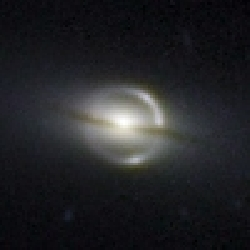
Finally, we have an edge-on lens surrounded by a near-complete Einstein ring (ID: 119674016). There are two darker lines extending horizontally along the length of the lens – this is dust within the lens galaxy, which acts to absorb some of the background light. The light of the source galaxy is relatively white/yellow, which indicates it could be made up of older stars, have dust that turns blue light red or be very distant (further analysis is needed to identify which it is), unlike many lensed sources which appear blue because of their young stellar population.
These amazing finds are just a small fraction of the lenses you’ve discovered so far and we can’t wait to see what else you’ll find. Thanks again for all your amazing classifications, happy classifying and we’ll see you on Talk!

