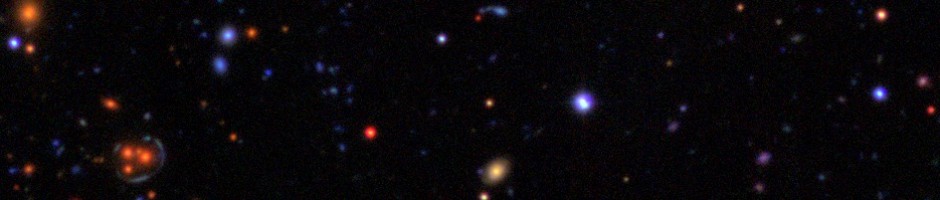
Revisiting the ESA Euclid Q1 search – What did we miss?
Saamie Vincken and Leon Roman Ecker are sharing an update on the additional subjects you inspected last summer in the ESA Euclid Quicklook-1 (Q1) area. They are finalising the final results and papers that we will share with you as soon as the Euclid Consortium gives us permission. Here’s a taster of what they found and we will share all of the new systems within the next few weeks.
Following the tremendous results from the Euclid Q1 strong lens search, we pored over the data to analyse what we had found, and how we might improve our methods for future searches. We identified two factors – improving our machine learning models even further and adjusting the criteria for choosing which galaxies to search through.
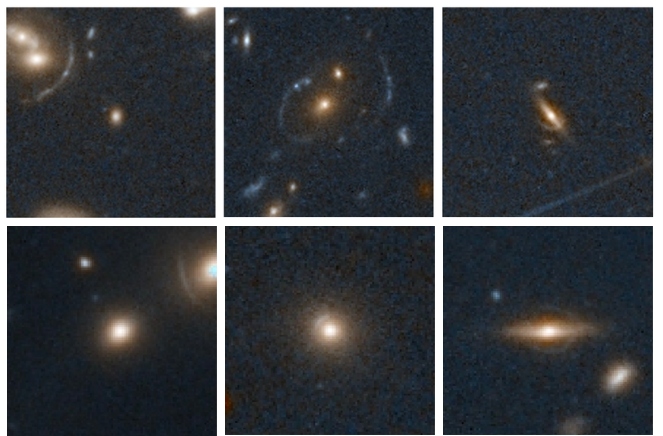
Improving our machine learning model (Saamie): During the initial Q1 lens search, several machine learning models were trained to identify lens candidates. Together with your classifications through Space Warps, we identified 500 strong lens candidates that we reported on here and here. Machine learning models often improve when trained on real data. Therefore, we retrained these models using confirmed Q1 lenses which significantly improved their performance. This iterative retraining will be important for future lens searches – Euclid is expected to reveal over 100,000 lenses over its lifetime, and using likely on-sky examples for retaining and removing as many non-lenses as possible from the dataset will be vital to ensure we can find many lenses as possible. We reapplied one of these networks to the Q1 dataset which identified additional lens candidates that had been missed in the first pass. With one of the improved networks, we repeated the inspection on the same Q1 subset and identified additional candidates that had been missed in the first pass. To ensure these were carefully checked, about 6000 newly flagged subjects were sent to Space Warps. Here are some of the new systems.
Refined selection criteria (Leon): We also discovered gaps in our Q1 galaxy selection – one of the original criteria we used for selecting galaxies that can act as light deflectors in Q1 meant that we overlooked nearby galaxies. These included spiral galaxies which we were keen to inspect – when acting as a lens (deflector), such spiral galaxies can be used as tests for General Relativity. Here are some examples of what we missed because of this.
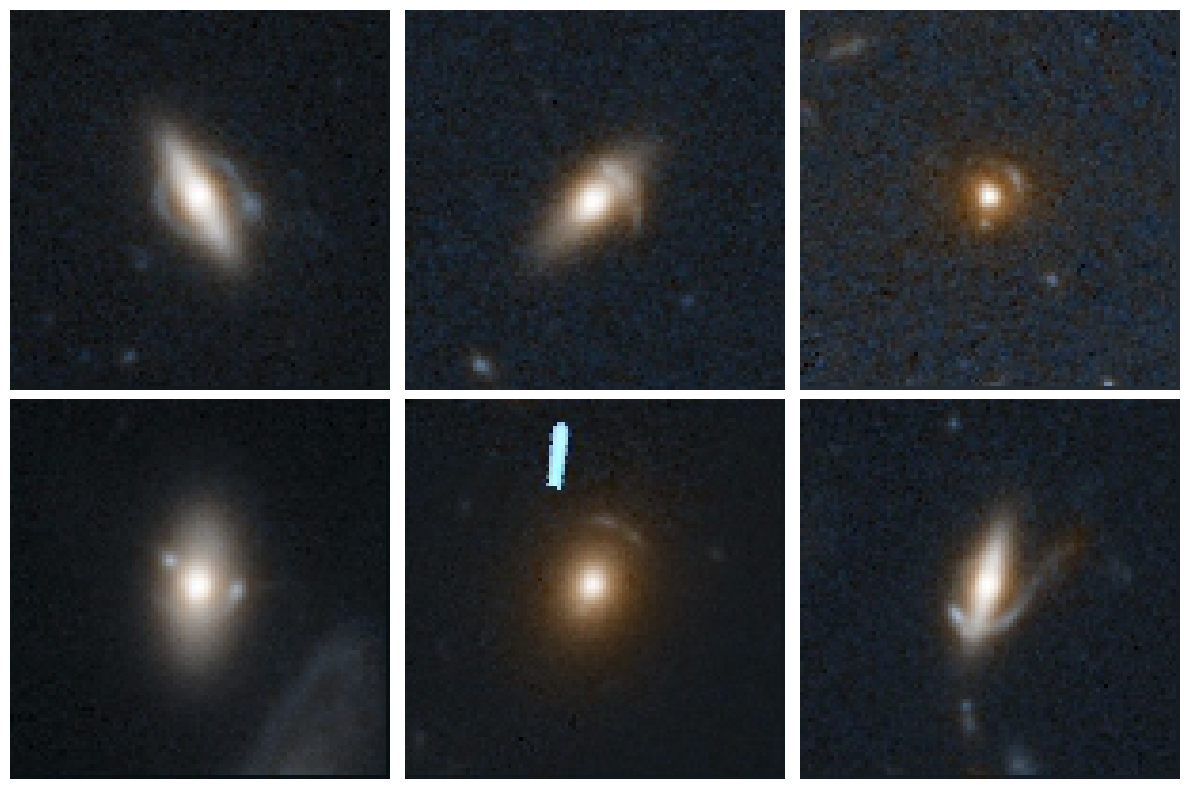
We’ve now corrected this error in the Q1 selections so going forward these kinds of galaxies will be included in the future searches.
Both of these adjustments meant that thousands of additional objects were flagged by the discovery systems as potential lenses. These objects were inspected thanks to the amazing efforts of the Space Warps volunteers, contributing to the discovery of over 50 additional promising strong lens candidates missed in the first search. These new systems are especially valuable, as they enrich the diversity of the sample and provide crucial input for retraining machine learning models. For the upcoming Euclid data, this will directly translate into a more complete and reliable identification of the lens population, boosting both the number and the quality of lenses we can uncover. The Space Warps volunteers have played a major role in making this effort a success allowing new mysteries of the Universe to be uncovered. Thank you!!
Upcoming blog posts are on Space Warps Refine, the full samples of new Q1 lenses, and a sneak peek at early results from our recent test search. Please stay tuned!
Space Warps helps to find 497 spectacular lenses in Euclid data
by Phil Holloway
Thanks to your incredible efforts, we are delighted to have found 497 strong lens candidates in Euclid Q1 data. Over the course of the project we had more than 800,000 classifications from over 1000 wonderful volunteers, and the results are a testament to your hard work. As part of the lens search, we developed the Strong Lens Discovery Engine, a pipeline to search for lenses in Euclid data, of which Space Warps was an integral part.
We found a whole range of lens candidates – a collage of our favourites is below, with a whole range of lens configurations. We also found 4 double-source-plane lenses! These are incredibly rare systems where the lensing galaxy deflects light from two different background galaxies, forming double rings/arcs.
We have temporarily removed these images while the Euclid Refine project is live
Credit: ESA/Euclid/Euclid Consortium/NASA, M. Walmsley, T. Li, N. Lines, and Euclid SL SWG
We have temporarily removed these images while the Euclid Refine project is live
Credit: Euclid Collaboration: Walmsley et al (2025)
As part of the Strong Lens Discovery Engine we used multiple machine learning algorithms (including ‘Zoobot’ trained using zooniverse classifications in Galaxy Zoo) to do an initial sift of the data which the Space Warps volunteers inspected to find the most likely lens candidates. This machine + volunteer partnership will be crucial with the much larger data releases coming soon from the Euclid survey. We also used Euclid’s incredible resolution to produce precise models of all the lens candidates and will continue to analyse these fascinating lenses for many months and years to come!
You can read the full results in the 5 science papers released today:
B: Lens search around massive galaxies,
C: Finding lenses with machine learning,
D: Double-source-plane lenses,
E: Lens classification combining machine learning and Space Warps.
Thank you again for your incredible hard work in finding these amazing lenses – we couldn’t have done it without you! Keep an eye out for future Space Warps projects – this initial data release was only 0.4% of the sky area of the full survey, so there will be many many more exciting lenses to find soon!
Stay tuned!
Phil and the Space Warps Team
Phil Holloway is a final year PhD student in the Department of Physics at Oxford and has done amazing work through his time with us including on Space Warps! We’re so thankful to Phil and to you all for making these results possible. Phil, Anu & Aprajita (Space Warps co-leads).
 Space Warps