Space Warps Refine – Honing in on our best lens candidates
Phil Holloway, Space Warps researcher, has put together a new project on the ESA Euclid first batch of data for you to try – read on to find out more.
From the hard work of the Space Warps volunteers (you!), we’ve now classified over 130,000 images from the ESA Euclid telescope. This was a hugely successful project thanks to all your contributions!
We’re very excited to launch the next stage; Space Warps Refine!! You might recall a similar project using CFHT-LS data (our very first Space Warps project) where we ran a second phase of the inspection aiming to carefully discern high scoring lens candidates; this project is in a similar vein. This time, you’ll be asked to look at the much smaller sample your crowd classifications generated and categorise the lens candidates into four grades: definite lens (A-grade), probable lens (B-grade), possible lens (C-grade) and not a lens (X-grade). This is a little different to the original Refine, where we asked you to clean the smaller sample with a yes or no. In this Refine inspection, we want to know your opinion on the likelihood of the lens.
This grading scheme is the same as the one researchers use to refine the larger sample of promising lens candidates into those that are most likely lenses. The highest grade candidates (the definite and probable lenses) are typically published as the lens candidates emerging from a survey.
You’ll notice the grades don’t have precise definitions or boundaries. In fact the final lens grading can be very subjective, and we are asking you to reflect on the system and let us know how likely you think a candidate is to be a strong lens system. For example, for some systems, it may be hard to decide between the ‘probable’ and ‘possible’ lens categories since the lensing signatures can be varied and not all images visible. Even if you are unsure we are asking you to select the grade that you think is best. There’s no absolute right or wrong answer and indeed researchers in strong lensing often disagree! As with the ‘classify’ stage, and as we do with the group of researchers, we will combine your grades to arrive at the final grade for any given candidate. The crowd grade will be the best impression we have for the likelihood of something being a likely or unlikely lens candidate.
To help guide you through the process, we’ve included some training images with detailed feedback. These feedback messages explain which characteristics to look out for, and why a given system might be given a high or low grade. As usual, you can also check out the Tutorial if you’re unsure of what to do. There are no wrong answers – we are really interested in which systems you think are the most likely lens candidates.
The feedback also includes info on how a small group of researchers graded the lens candidate. In some cases you’ll notice strong agreement between the researchers, in others a much wider spread. We want to know your thoughts, even if they are diverse, this information from your crowd grading can also tell us about the kind of systems that are unclear versus those that aren’t.
This project is a proof-of-concept study, preparing us for much larger datasets of strong lenses which we’ll find with the ESA Euclid telescope. From our models, we’re expecting to find roughly 100,000 strong lens systems in the ESA Euclid data nestled within samples that are factors of a few to ten times larger, this is far more than the researchers can handle without your help! We’re aiming to get a purer sample of strong lenses by separating out the systems which show clear lensing features from those which might be non-lenses (false positives).
For the initial launch, we’re including around 10,000 images that your crowd inspection identified from the ‘classify’ work flow for refinement. These include lenses which received high scores from Space Warps volunteers in our initial ESA Euclid lens search, as well as some simulated lenses. You should therefore expect a higher proportion of interesting lens candidates in this grading workflow than the classification stream.
I have recorded a short talk on the results from our Euclid lens search, as well as more details on this `Refine’ stage. Do take a look and ask any questions which come up on our dedicated talk forum here.
Thanks again for all your contributions – we can’t wait to see what you find. Happy refining!

Space Warps finds new lenses in the Dark Energy Survey
A while ago, we ran a project lead by Jimena Gonzalez Lozano ran the FIRST machine learning+citizen inspection system to find strong gravitational lenses searching all of galaxies in the Dark Energy Survey.
The machine learning model makes use of the transformer encoder, which is based on the attention mechanism. Transformers were originally designed for natural language processing tasks. However, they can also be employed in image-processing tasks — like facial recognition in photographs — that in our case score images on their likelihood of being a gravitational lens. All of you then helped to sift through these likely candidates producing amazing results! A few words from Jimena…
Thank You for Helping Us Discover Hundreds of Strong Lenses!
Thanks to the incredible efforts of hundreds of volunteers who classified over 20,000 images, we have identified hundreds of strong gravitational lenses! After carefully reviewing the highest-scored images, we classified the final candidates into three categories based on confidence:
• 149 “definite” lenses
• 516 “probable” lenses
• 663 “could-be” lenses
You can find the full results in our publication available on arXiv, where Figures 12–15 showcase examples of candidates from each confidence category. Below is an image highlighting some of the high-confidence strong lenses that had not been identified before!

This project holds the record for finding the most strong lenses in the Dark Energy Survey. Additionally, we found that our machine learning methodology produces significantly fewer false positives (incorrect lens classifications) than previous techniques. This makes it a powerful tool for the next generation of astronomical surveys, where we will be dealing with massive amounts of data.
Importantly, even the images classified as not being lenses are valuable! They can be used to train future machine learning models, helping refine and improve their accuracy.
Finally, here is a collage showcasing the incredible diversity of strong lenses discovered in this project—featuring a variety of shapes, sizes, and colors.
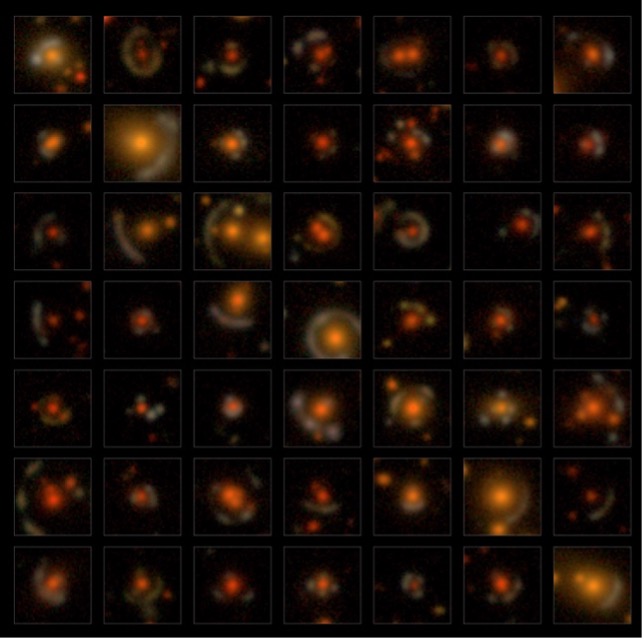
A collage of strong lenses that you helped to identify! This image was the winning entry in the UW-Madison 2023 Cool Science Image Contest.
Thank you once again for your time and dedication. Your contributions have made a real impact on the search for these rare cosmic phenomena!
Jimena and the Space Warps Team
 Space Warps