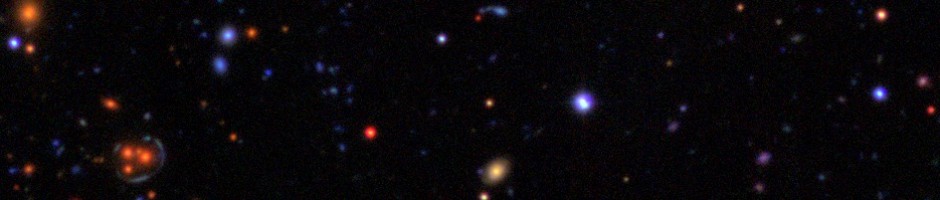
Half-a-million classifications!!
An amazing effort, thank you for your classifications! Here’s an update on your recent classifications from Phil Holloway.
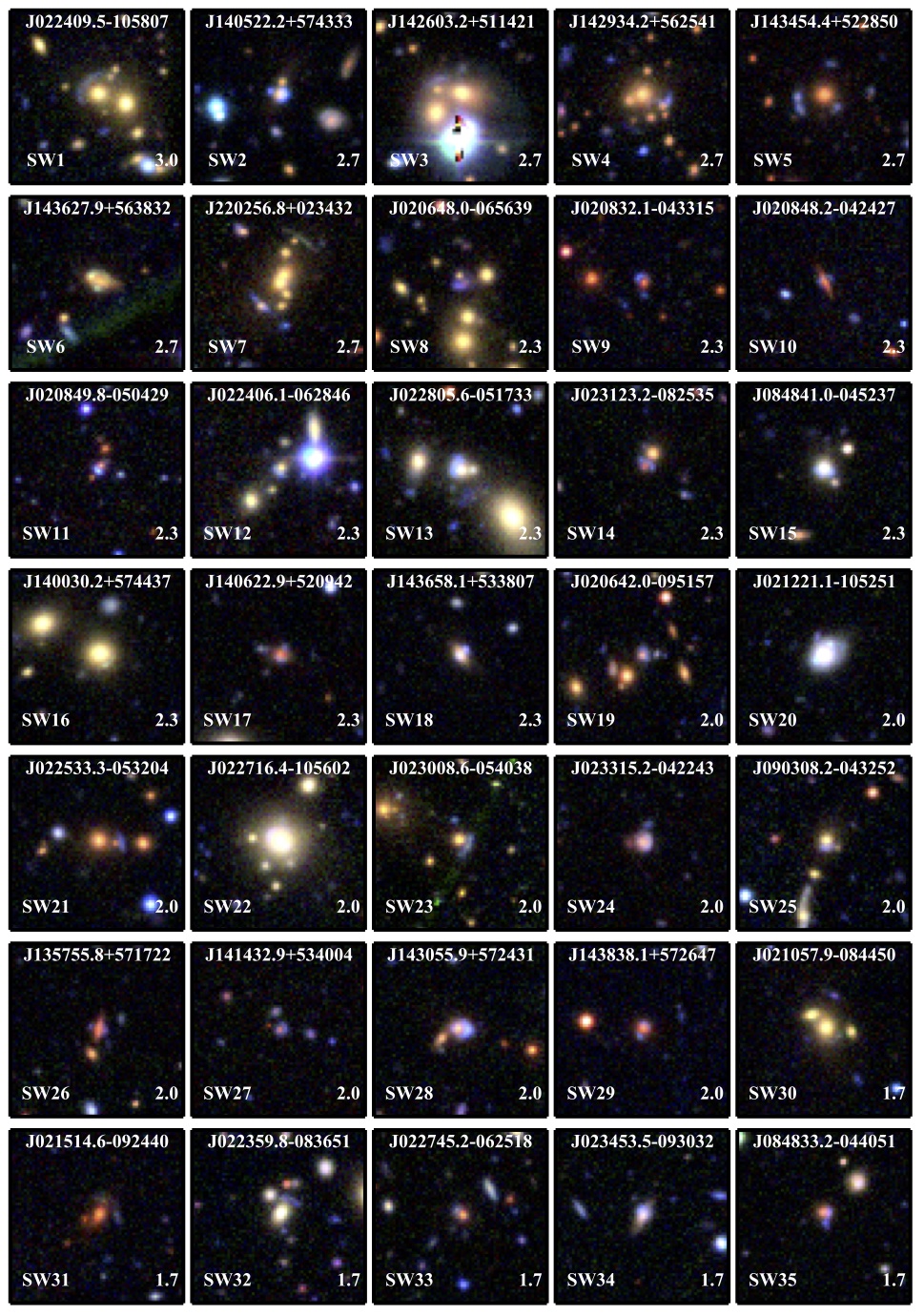
A huge thank you to everyone who contributed to the latest ESA Euclid lens test search – over the this test project you’ve collectively made an impressive half-a-million classifications, and identified some amazing lens candidates. The science team are now carefully going through all of the high scoring candidates you identified (this blog post summarises how the classifications are combined to arrive at the high scoring candidates). We’re not as fast as you all, and we don’t always agree, so it will take some time to get to the final results but we will keep you posted here as the sample emerges. We’re very excited to see the systems you identified, and below is a preview of some of the amazing lens candidates that we particularly liked – we hope you do too!
Amongst the beautiful lens candidates you have found, there have been some edge-on spiral lenses (centre), group-scale lenses (centre-left), and galaxy-scale lenses with clear counter images (far left/far right). Seeing counter-images give us extra confidence that a system is a genuine strong lens system, while edge-on lenses can be used to test our theories of gravity and dark matter.
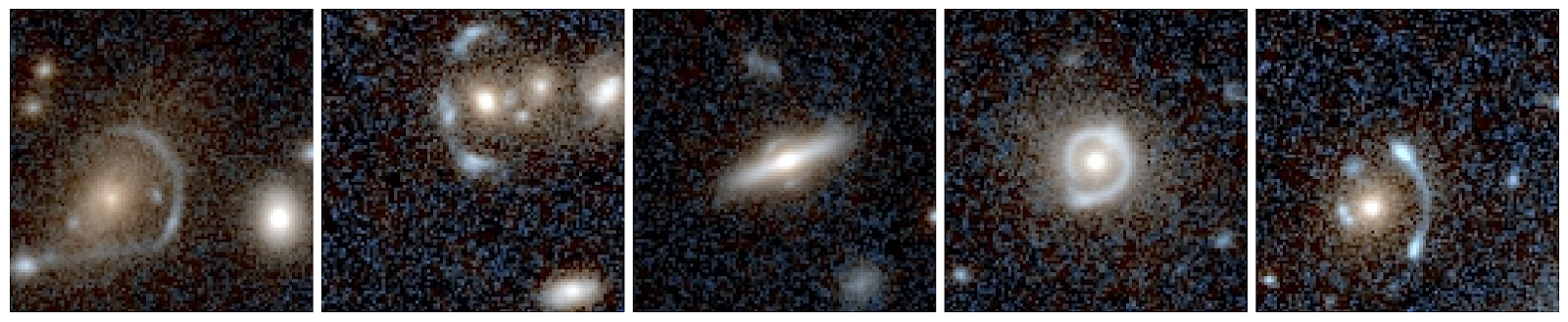
As a reminder, these candidates come from a small amount of test data (about 50 deg2 of the sky), we expect there will be few hundred high quality lens candidates in this area among your high scoring systems.
Euclid will eventually survey an area of around 14,000 deg2, 280 times larger tan this test area, so there are lots more lenses to come!!
Thanks again for all your contributions – Space Warps will return very soon so please watch this space!
Revisiting the ESA Euclid Q1 search – What did we miss?
Saamie Vincken and Leon Roman Ecker are sharing an update on the additional subjects you inspected last summer in the ESA Euclid Quicklook-1 (Q1) area. They are finalising the final results and papers that we will share with you as soon as the Euclid Consortium gives us permission. Here’s a taster of what they found and we will share all of the new systems within the next few weeks.
Following the tremendous results from the Euclid Q1 strong lens search, we pored over the data to analyse what we had found, and how we might improve our methods for future searches. We identified two factors – improving our machine learning models even further and adjusting the criteria for choosing which galaxies to search through.
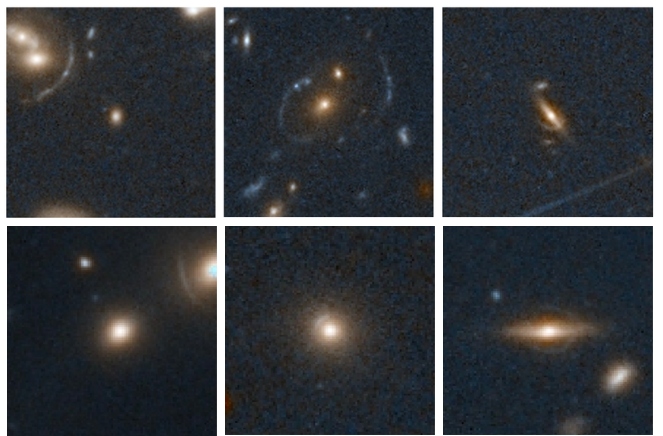
Improving our machine learning model (Saamie): During the initial Q1 lens search, several machine learning models were trained to identify lens candidates. Together with your classifications through Space Warps, we identified 500 strong lens candidates that we reported on here and here. Machine learning models often improve when trained on real data. Therefore, we retrained these models using confirmed Q1 lenses which significantly improved their performance. This iterative retraining will be important for future lens searches – Euclid is expected to reveal over 100,000 lenses over its lifetime, and using likely on-sky examples for retaining and removing as many non-lenses as possible from the dataset will be vital to ensure we can find many lenses as possible. We reapplied one of these networks to the Q1 dataset which identified additional lens candidates that had been missed in the first pass. With one of the improved networks, we repeated the inspection on the same Q1 subset and identified additional candidates that had been missed in the first pass. To ensure these were carefully checked, about 6000 newly flagged subjects were sent to Space Warps. Here are some of the new systems.
Refined selection criteria (Leon): We also discovered gaps in our Q1 galaxy selection – one of the original criteria we used for selecting galaxies that can act as light deflectors in Q1 meant that we overlooked nearby galaxies. These included spiral galaxies which we were keen to inspect – when acting as a lens (deflector), such spiral galaxies can be used as tests for General Relativity. Here are some examples of what we missed because of this.
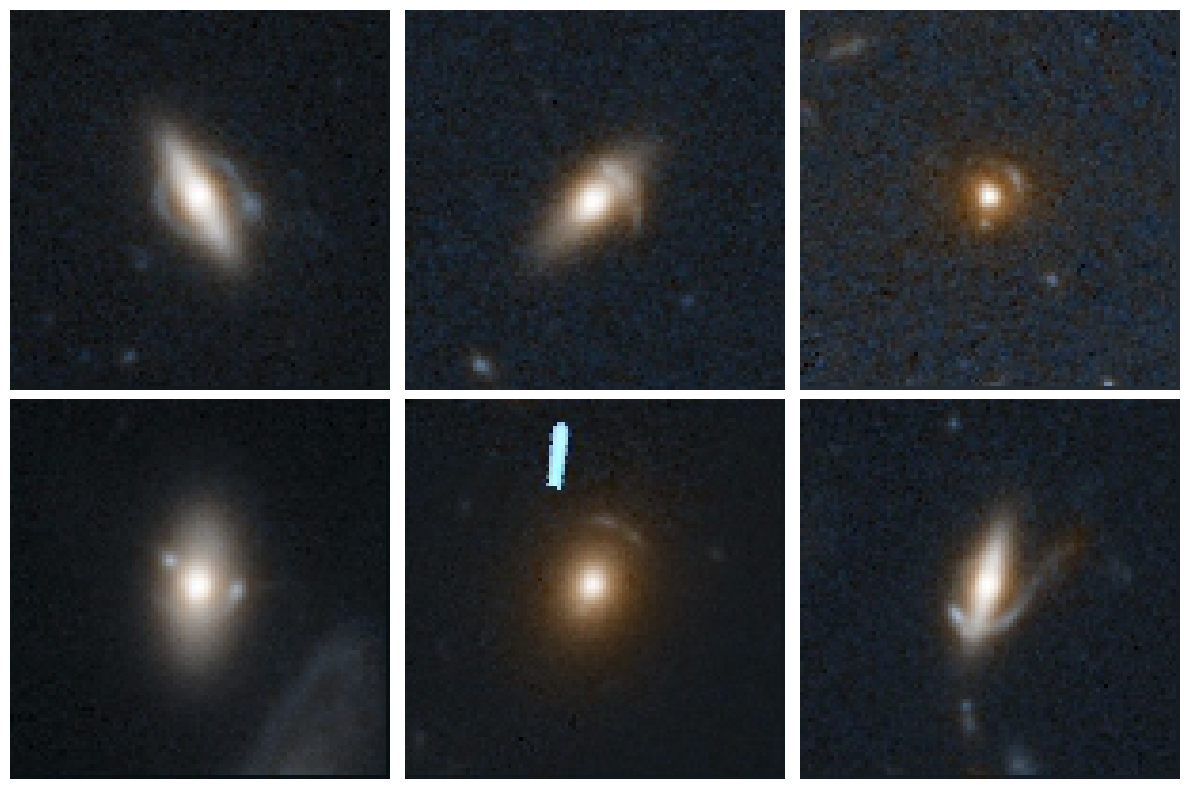
We’ve now corrected this error in the Q1 selections so going forward these kinds of galaxies will be included in the future searches.
Both of these adjustments meant that thousands of additional objects were flagged by the discovery systems as potential lenses. These objects were inspected thanks to the amazing efforts of the Space Warps volunteers, contributing to the discovery of over 50 additional promising strong lens candidates missed in the first search. These new systems are especially valuable, as they enrich the diversity of the sample and provide crucial input for retraining machine learning models. For the upcoming Euclid data, this will directly translate into a more complete and reliable identification of the lens population, boosting both the number and the quality of lenses we can uncover. The Space Warps volunteers have played a major role in making this effort a success allowing new mysteries of the Universe to be uncovered. Thank you!!
Upcoming blog posts are on Space Warps Refine, the full samples of new Q1 lenses, and a sneak peek at early results from our recent test search. Please stay tuned!
Space Warps Refine – Honing in on our best lens candidates
Phil Holloway, Space Warps researcher, has put together a new project on the ESA Euclid first batch of data for you to try – read on to find out more.
From the hard work of the Space Warps volunteers (you!), we’ve now classified over 130,000 images from the ESA Euclid telescope. This was a hugely successful project thanks to all your contributions!
We’re very excited to launch the next stage; Space Warps Refine!! You might recall a similar project using CFHT-LS data (our very first Space Warps project) where we ran a second phase of the inspection aiming to carefully discern high scoring lens candidates; this project is in a similar vein. This time, you’ll be asked to look at the much smaller sample your crowd classifications generated and categorise the lens candidates into four grades: definite lens (A-grade), probable lens (B-grade), possible lens (C-grade) and not a lens (X-grade). This is a little different to the original Refine, where we asked you to clean the smaller sample with a yes or no. In this Refine inspection, we want to know your opinion on the likelihood of the lens.
This grading scheme is the same as the one researchers use to refine the larger sample of promising lens candidates into those that are most likely lenses. The highest grade candidates (the definite and probable lenses) are typically published as the lens candidates emerging from a survey.
You’ll notice the grades don’t have precise definitions or boundaries. In fact the final lens grading can be very subjective, and we are asking you to reflect on the system and let us know how likely you think a candidate is to be a strong lens system. For example, for some systems, it may be hard to decide between the ‘probable’ and ‘possible’ lens categories since the lensing signatures can be varied and not all images visible. Even if you are unsure we are asking you to select the grade that you think is best. There’s no absolute right or wrong answer and indeed researchers in strong lensing often disagree! As with the ‘classify’ stage, and as we do with the group of researchers, we will combine your grades to arrive at the final grade for any given candidate. The crowd grade will be the best impression we have for the likelihood of something being a likely or unlikely lens candidate.
To help guide you through the process, we’ve included some training images with detailed feedback. These feedback messages explain which characteristics to look out for, and why a given system might be given a high or low grade. As usual, you can also check out the Tutorial if you’re unsure of what to do. There are no wrong answers – we are really interested in which systems you think are the most likely lens candidates.
The feedback also includes info on how a small group of researchers graded the lens candidate. In some cases you’ll notice strong agreement between the researchers, in others a much wider spread. We want to know your thoughts, even if they are diverse, this information from your crowd grading can also tell us about the kind of systems that are unclear versus those that aren’t.
This project is a proof-of-concept study, preparing us for much larger datasets of strong lenses which we’ll find with the ESA Euclid telescope. From our models, we’re expecting to find roughly 100,000 strong lens systems in the ESA Euclid data nestled within samples that are factors of a few to ten times larger, this is far more than the researchers can handle without your help! We’re aiming to get a purer sample of strong lenses by separating out the systems which show clear lensing features from those which might be non-lenses (false positives).
For the initial launch, we’re including around 10,000 images that your crowd inspection identified from the ‘classify’ work flow for refinement. These include lenses which received high scores from Space Warps volunteers in our initial ESA Euclid lens search, as well as some simulated lenses. You should therefore expect a higher proportion of interesting lens candidates in this grading workflow than the classification stream.
I have recorded a short talk on the results from our Euclid lens search, as well as more details on this `Refine’ stage. Do take a look and ask any questions which come up on our dedicated talk forum here.
Thanks again for all your contributions – we can’t wait to see what you find. Happy refining!

Space Warps helps to find 497 spectacular lenses in Euclid data
by Phil Holloway
Thanks to your incredible efforts, we are delighted to have found 497 strong lens candidates in Euclid Q1 data. Over the course of the project we had more than 800,000 classifications from over 1000 wonderful volunteers, and the results are a testament to your hard work. As part of the lens search, we developed the Strong Lens Discovery Engine, a pipeline to search for lenses in Euclid data, of which Space Warps was an integral part.
We found a whole range of lens candidates – a collage of our favourites is below, with a whole range of lens configurations. We also found 4 double-source-plane lenses! These are incredibly rare systems where the lensing galaxy deflects light from two different background galaxies, forming double rings/arcs.
We have temporarily removed these images while the Euclid Refine project is live
Credit: ESA/Euclid/Euclid Consortium/NASA, M. Walmsley, T. Li, N. Lines, and Euclid SL SWG
We have temporarily removed these images while the Euclid Refine project is live
Credit: Euclid Collaboration: Walmsley et al (2025)
As part of the Strong Lens Discovery Engine we used multiple machine learning algorithms (including ‘Zoobot’ trained using zooniverse classifications in Galaxy Zoo) to do an initial sift of the data which the Space Warps volunteers inspected to find the most likely lens candidates. This machine + volunteer partnership will be crucial with the much larger data releases coming soon from the Euclid survey. We also used Euclid’s incredible resolution to produce precise models of all the lens candidates and will continue to analyse these fascinating lenses for many months and years to come!
You can read the full results in the 5 science papers released today:
B: Lens search around massive galaxies,
C: Finding lenses with machine learning,
D: Double-source-plane lenses,
E: Lens classification combining machine learning and Space Warps.
Thank you again for your incredible hard work in finding these amazing lenses – we couldn’t have done it without you! Keep an eye out for future Space Warps projects – this initial data release was only 0.4% of the sky area of the full survey, so there will be many many more exciting lenses to find soon!
Stay tuned!
Phil and the Space Warps Team
Phil Holloway is a final year PhD student in the Department of Physics at Oxford and has done amazing work through his time with us including on Space Warps! We’re so thankful to Phil and to you all for making these results possible. Phil, Anu & Aprajita (Space Warps co-leads).
Space Warps finds new lenses in the Dark Energy Survey
A while ago, we ran a project lead by Jimena Gonzalez Lozano ran the FIRST machine learning+citizen inspection system to find strong gravitational lenses searching all of galaxies in the Dark Energy Survey.
The machine learning model makes use of the transformer encoder, which is based on the attention mechanism. Transformers were originally designed for natural language processing tasks. However, they can also be employed in image-processing tasks — like facial recognition in photographs — that in our case score images on their likelihood of being a gravitational lens. All of you then helped to sift through these likely candidates producing amazing results! A few words from Jimena…
Thank You for Helping Us Discover Hundreds of Strong Lenses!
Thanks to the incredible efforts of hundreds of volunteers who classified over 20,000 images, we have identified hundreds of strong gravitational lenses! After carefully reviewing the highest-scored images, we classified the final candidates into three categories based on confidence:
• 149 “definite” lenses
• 516 “probable” lenses
• 663 “could-be” lenses
You can find the full results in our publication available on arXiv, where Figures 12–15 showcase examples of candidates from each confidence category. Below is an image highlighting some of the high-confidence strong lenses that had not been identified before!

This project holds the record for finding the most strong lenses in the Dark Energy Survey. Additionally, we found that our machine learning methodology produces significantly fewer false positives (incorrect lens classifications) than previous techniques. This makes it a powerful tool for the next generation of astronomical surveys, where we will be dealing with massive amounts of data.
Importantly, even the images classified as not being lenses are valuable! They can be used to train future machine learning models, helping refine and improve their accuracy.
Finally, here is a collage showcasing the incredible diversity of strong lenses discovered in this project—featuring a variety of shapes, sizes, and colors.
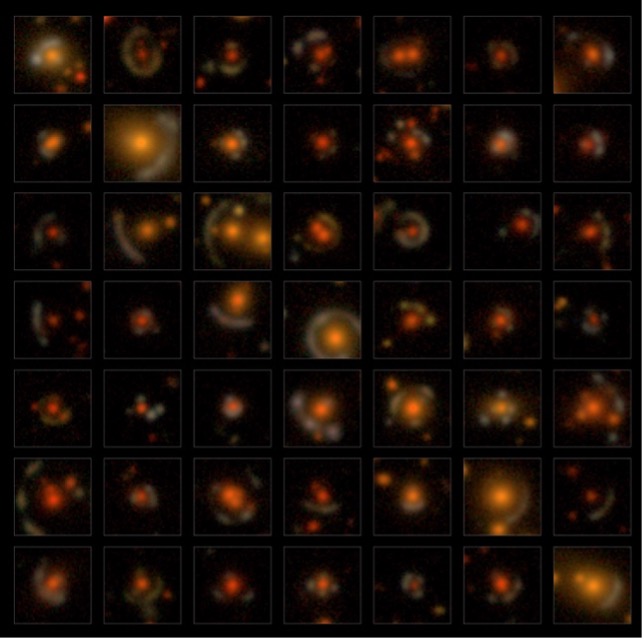
A collage of strong lenses that you helped to identify! This image was the winning entry in the UW-Madison 2023 Cool Science Image Contest.
Thank you once again for your time and dedication. Your contributions have made a real impact on the search for these rare cosmic phenomena!
Jimena and the Space Warps Team
Space Warps is back!!
We’ve launched a brand new search with the Dark Energy Survey (DES) and we need your help to find more strong gravitational lenses!!
Jimena Gonzalez Lozano has been hunting for lenses in the wide area Dark Energy Survey using a machine learning code called Vision Transformer. But because there are lots of things in the Universe that can mimic strong lenses, and because it’s hard to get lots of example strong lenses to train the machine learning codes, it’s still very hard to find strong lens candidates. This is where you come in, we’d love for your to take a look at the data and find some lenses. All you need to do is look at the images presented, click if you think it’s a lens otherwise press done. In just a few minutes you can contribute significantly to identifying the most probable lens candidates. And if you are worried about getting it wrong, please don’t be – we average many classifications before we accept or reject a candidate. We’ve only been running a short time but you (as the crowd) are already finding some previously undiscovered systems. If you have a spare few minutes, please give us a hand at spacewarps.org … Every click counts!!!!
New lenses in the HSC!
By Alessandro Sonnenfeld, Aprajita Verma & Anupreeta More for the SW-HSC team
We did it!
Thousands of you, making millions of classifications, have succeeded at classifying 300,000 images of galaxies in only five months after the launch of the SW-HSC campaign! Well done – what an amazing effort!
We’re currently reviewing the lens candidates with the highest scores, and we’re impressed with the quantity and the variety of lenses that have been discovered.
One of the best candidates is subject ‘20986142‘, with the unmistakable four image ‘quad’ configuration of a lensed compact source, possibly a faint quasar. This is also one of the most distant lens galaxies in our sample (we are seeing its light at about half the age of the observable Universe), a useful feature for the study of how galaxies evolve in time.
Another impressive lens is subject ‘21000104‘, consisting of two massive galaxies close to each other which, thanks to their combined lensing power, produce a set of multiple images with large angular separation. All of the citizens who inspected this candidate classified it as a lens, making it one of the few systems with a perfect score, and rightly so!

Three new SW-HSC promising lens candidates found in the latest SW search. The same image is shown in the top and bottom rows, but with lensing galaxy subtracted in the bottom row.
There are also nearly a dozen disk galaxies identified as lenses, like system ‘21067892‘. Not many disk lenses were previously known, making these new discoveries very useful for the study of this particular class of objects, including their masses.
We are working on refining the final SW-HSC sample and will post-back with more details soon. Based on our early inspection, we certainly expect that you have discovered more than a hundred new strong lenses!
Thank you so much for your classifications! This success would be impossible without each and every one of you. We look forward to sharing all the new lensed candidates that you have discovered soon — watch this space…
Space Warps is back! First discoveries from the Hyper Suprime-Cam Survey
By Alessandro Sonnenfeld, Anupreeta More and Aprajita Verma
Space Warps is back! A new campaign, launched last Friday in collaboration with Science Friday, is aiming to collect 1 million classifications to discover gravitational lenses among 300,000 images of galaxies from the Hyper Suprime-Cam instrument on the Japanese 8.2m Subaru Telescope, Mauna Kea.
Classifications are ongoing, we’re just shy of 900,000, but a few lenses have already been discovered. A very interesting one among these is ‘Subject 21035634‘ (real name and coordinates will be revealed in a scientific paper once the campaign is over), which the Space Warps crowd has ranked with a perfect score of 1 (meaning it’s a highest probability lens candidate)!
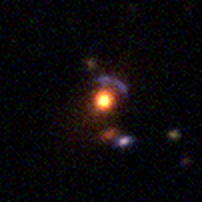
Lens candidate 21035634 discovered in Space Warps – HSC
This candidate gravitational lens stands out for its aesthetics, with a nice blue arc seen through an extended envelope of stars from the lens galaxy, as well as its distance: the lens is located between 6 and 7 billion light years away. Finding distant lenses is one of the main goals of this project, and we expect there to be dozens of lenses at an even higher distance than this one.
Can you help us reach our 1 million classifications in 1 week goal and help us find more lenses? Visit spacewarps.org – every classification counts!
Subject 21035634 has been correctly identified as lens by the following users: HexBerry, aussiegoodstuff, JSChris, ChronoTrigger, Dolorous_Edd, Pixelstain, tkuhnle, mitch, 770120179, John_M_Cummins, graham_d, ElisabethB, Bajari,Agumo, c.petty, nilium, HappyAmethyst, paulamichelllle, Bepkoam, CRuthWilliams,
It was flagged first on Space Warps Talk by user @Dolorous_Edd.
Your work in print!: Space Warps CFHTLS papers accepted for publication
We’re really pleased to announce that our papers on the first Space Warps gravitational lens search on the Canada France Hawaii Telescope Legacy Survey (CFHTLS) have been accepted by the Monthly Notices of the Royal Astronomical Society, and will appear online and in print next month. In the meantime, you can find the accepted papers at Paper I & Paper II.
We’ve also resurrected the Space Warps site and are eagerly awaiting your classifications! You’ll be able to look at some CFHTLS images that have been seen before but we think are likely to contain interesting objects that didn’t quite make it into our final sample according to the analysis pipeline we ran while the project was live. Subsequently, Chris Davis, a research student who works with Phil at SLAC, put together an “offline” analysis that considers your classifications slightly differently. This threw up some new candidates that we would like your second opinion on. These may be false positives (i.e. objects that look like lenses but aren’t), difficult candidates (where you all didn’t agree), or genuinely missed candidates (not enough people viewed them). There’s an example of a missed simulated lens below. Check-out the Spotter’s Guide to refresh your memory on real lenses, false positives and artifacts. There are far fewer images this time round so you may find yourself out of subjects quickly.
We’ve also prepared a few articles from our home institutes that will come out today (Thursday 24th September) to mark the acceptance – a press release from Anu’s home institute in Tokyo, Kavli IPMU, a Symmetry article (online this afternoon) from SLAC, Phil’s home institute, and an Oxford Science Blog post from my home institute – so watch out for those!
We’re hoping that we may get to meet a few new lens spotters as a result of the articles, so please do help out any newbies you spot on Talk if you get the chance! Some of the images you see may already have been discussed on Talk as potential lenses as well, so please do add to those discussions too.
Happy classifying!
Aprajita.
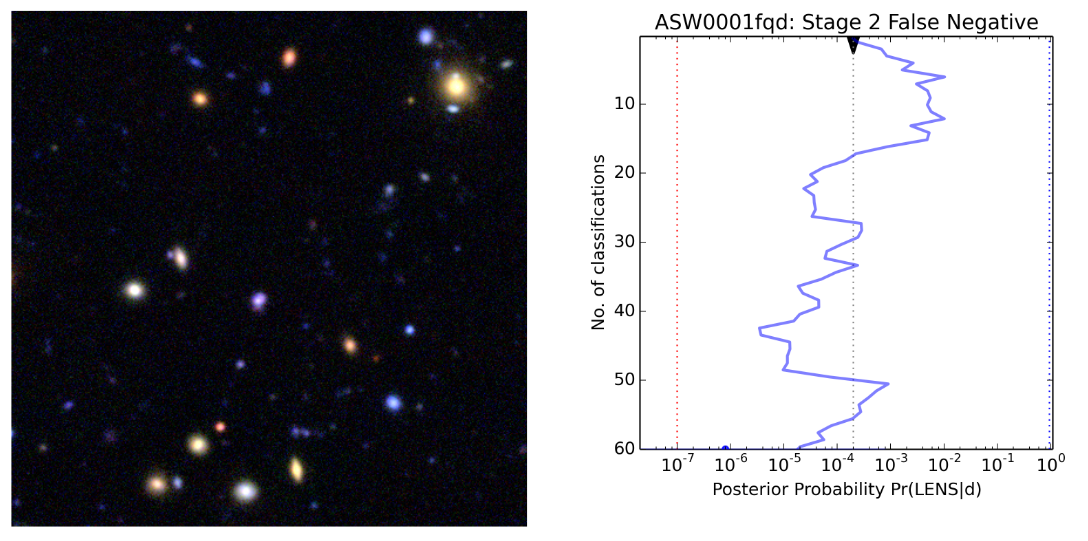
The image on the left shows a training image used in Space Warps. We inserted a simulated lens (top right) and this was presented as part of the classification stream. The right panel shows how it was classified by each viewer, the number of views increases from top to bottom. Each kink in the blue line indicates each new classification. Moves to the left indicate those who thought there was no lens here, and moves to the right show those who did. Overall the source stayed roughly 50:50, so the community classification for this object was undecided. A community classified lens candidate would lie to the right of this plot (trajectory crossing the blue dotted line on the right), and an image containing no lens candidate would cross the red dotted line on the left. Similarly, real (non-training/non-simulated) lenses may have been undecided in the CFHTLS search. We are now asking you to view some more images that could contain potential lens candidates that didn’t quite meet our detection threshold in the initial search.
Space Warps: New Candidate Gravitational Lenses in the CFHTLS!
It’s been a while, but we are very pleased to be able to write to you today with the results of the first Space Warps project launched in May 2013. We asked for your help with finding lenses which may have been missed by robotic searches in the Canada France Hawaii Telescope Legacy Survey (CFHTLS) imaging. We have now combined and analysed all your classifications, and carefully sifted through the results. It’s good news: in addition to finding 80 previously published candidate gravitational lenses, you helped discover 29 new candidate gravitational lenses (and another 30 objects that might turn out be lenses). Nice work, people!
We just posted two research papers on the “arxiv” pre-print server (where astronomers put their work for their colleagues to read), showing our results from our first project. You can check out the two papers here and here. The first paper is about how well “the system” (that’s you!) performed, in terms of spotting the sims and rejecting the duds. The second paper is about the new lens candidates that you found – and how they compare with the “known lenses” that two robots had previously found.
We’ll be submitting these papers to an astronomy journal (Monthly Notices of the Royal Astronomical Society) in a couple of weeks, so if you have comments or questions about either paper, you can post them as “issues” on the Space Warps GitHub repository, and we’ll work them into the text in the meantime. Thanks!
So, what do we mean by “candidates” that “might turn out to be lenses”? A few of the objects you found are clearly gravitational lenses – we can tell just by looking at them. For those that are less obvious, making a model that reproduces the image configurations seen can give us more confidence. While we were working on putting the sample together, Rafael Kueng and Prasenjit Saha wrote up a test of their web-based lens modeling software, which some of you took part in – you can read their paper on the arxiv too!
Here is an example of what astronomers can do with the candidate lenses that you discover – Since you found this amazing red ring (called 9io9 based on your popular choice) in the VICS82 project last January, Jim Geach (co-PI of VICS82) and his team have been busy making more observations with a variety of telescopes. They recently finished analyzing the data. Jim, Aprajita and others helped confirm that 9io9 is indeed a lens with spectroscopy, and Anupreeta and Neal Jackson (University of Manchester) made a well-constrained mass model of the system to understand how magnified is the red galaxy in the background. This red lensed galaxy turns out to be pretty interesting – check out the paper to find out more.
We’ll write more on all this good stuff in the coming weeks. If you like, ask us a question in the comments below, and we’ll try and answer them as we go 🙂
Thanks for all your classifications, these are very exciting results!
Phil, Aprajita, and Anupreeta
 Space Warps