Narrowing down the ESA Euclid lens sample
Last year we launched Space Warps Refine, a project where we asked you to be more discerning than ‘Classify’ and grade the lens candidates according to your confidence they were genuine lenses. We took your collective grades and have been poring over the interesting results. Phil Holloway shares his summary of Refine below along with an exciting update on the Euclid DR1 lens candidates.
In recent years, telescope surveys have grown larger, deeper, and higher in the detail (or resolution) we can see in their imaging. Eventually we expect to discover more than 100,000 strong lenses. The space-based Euclid telescope is enabling the discovery of many of these systems, and through your tremendous efforts we have already made great progress using the Euclid Q1 data (summarised here and here).
Traditionally, following a lens search, researchers have sorted candidates into classes based on their confidence that each is a genuine lens system. However, with so many promising lens candidates arriving from Euclid, the number of lens candidates is huge!! Last year in Space Warps Refine, you did a tremendous job in helping us find the best method for separating the most compelling lens candidates from the more ambiguous ones, while also identifying candidates that our team might have overlooked in their inspection. We want to share some of those results with you.
Given the huge number of lens candidates that we will identify in forthcoming Euclid data releases, minimising the number of classifications required for each system will be key. However, as you have experienced, lens grading can be subjective and we don’t want to miss genuine systems so crowd classifications are really important. Your classifications in Space Warps Refine show that a consensus grade can be reached much faster for definite lenses and definite non-lenses than those that are more ambiguous intermediate systems (‘probable’ and ‘possible’ lenses). We find the same result when using your classifications and when using the grades from strong lens researchers. This is really good news because we want to find the most reliable and highest grade systems and get rid of the lowest grade systems as fast as possible. Rapidly reaching a consensus grade on these systems means we can start working on them early and then focus on more ambiguous intermediate systems which can be much more subjective.
Your independent classifications have also allowed us to see what the researchers overlooked. Below are a selection of systems which you graded higher than the researchers.
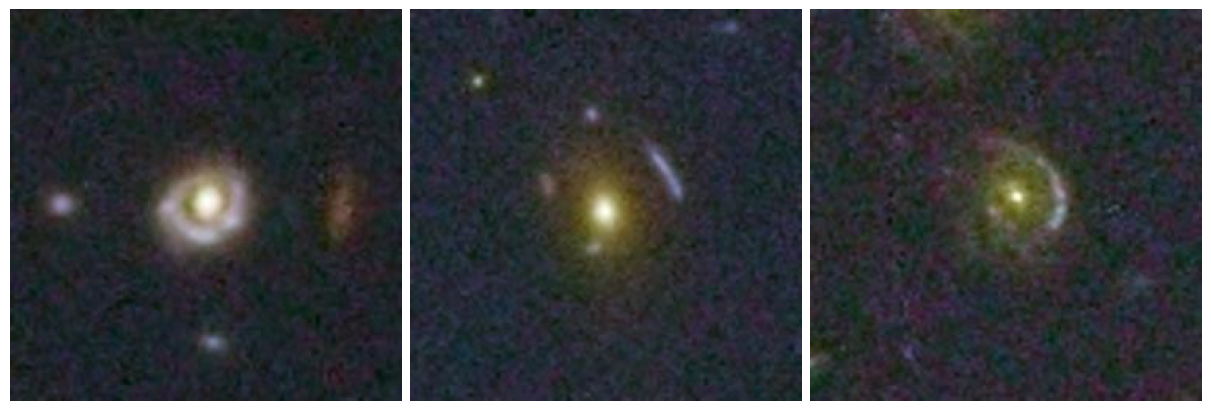
Center: This system has a blue arc to the right-hand side of the central galaxy. Researchers graded this as a ‘possible’ lens. The blue arc appears to be deflected round the central galaxy but no counter-image is visible (a tell-tale sign of a strong lens). While the mass of the central galaxy has likely caused this deflection, it may not be massive enough to produce multiple-imaging. Nevertheless, gravitational lensing is at work here!
Right: Researchers graded this system as a non-lens, whereas Space Warps volunteers classed this as a probable lens system. It does have some classic characteristic features of a strong lens so perhaps the researchers were too hasty! There is a blue arc on the right-hand-side, deflected round the central galaxy. On the left-hand-side there is a small bright clump, with a similar colour to the larger arc. This configuration is plausible for an arc + counter-image lensed system. However, there are some features which are more unusual for a lens – there is a faint arc extending further upwards anticlockwise from the right-hand arc, and the central galaxy is relatively small (faint) to produce lensing. We can’t be sure what is happening here – is it an unusual lens system, or an imposter?
A huge thank you to everyone who took part in Space Warps Refine last year – your contributions have been truly incredible! I’ll post the draft paper soon so you can see the full analysis.
What’s next? The results from last year’s Space Warps Refine are hugely exciting, and are informing our strategy for inspecting the huge number of strong lens candidates which will be identifiable with the Euclid satellite and beyond. Indeed, your success means we would like to ask for you help in “Refining” the early candidates that are emerging from your incredible classifications on the first batch of Euclid Data Release 1 data. So many great candidates are emerging, please join us and have a closer look at these beautiful and fascinating finds!!

