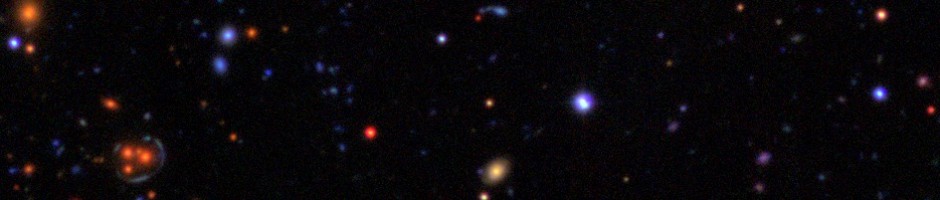
Engage!
Hooray! Space Warps is live, and the spotters are turning up in numbers. Check out the site at spacewarps.org – there’s a few little bugs that Anu, Surhud and the dev team are ironing out, but basically it’s looking pretty good! Thanks very much to everyone who’s helped out in the last few months – your feedback has been very useful indeed in designing a really nice, easy to use website that hopefully will enable many new discoveries. And to all of you who are new to Space Warps – welcome!
If you’re feeling really keen, why don’t you come and hang out in the discussion forum at talk.spacewarps.org? We’re starting to tag images to help organise them, and the more interesting conversations we have there, the more useful it will be for the newer volunteers. And of course, you can vote on the candidates spotted by other people, by making your own collection. Come and take part in the Space Warps collaboration!
PS. Aprajita and I will be making a special guest appearance on the regular Galaxy Zoo Hangout tomorrow – tune in for more slightly distorted spacetime chat!

Space Warps CFHTLS
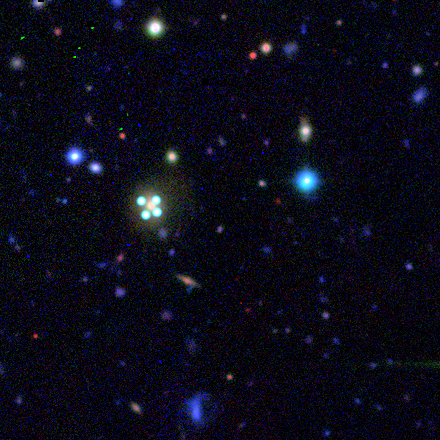
A simulated lens quasar, the likes of which we hope to find during Space Warps’ first project.
Our first project is to search the 400,000 images of the Canada France Hawaii Telescope Legacy Survey, or CFHTLS – we’re asking people to spot gravitational lenses in its images, in order to find some new examples, and also to learn how to design automated lens detection systems to use in the future. I caught up with Jean-Paul Kneib, from the Strong Lenses in the Legacy Survey (SL2S) project, and Space Warps co-PI Anupreeta More to ask them to explain a bit more about it.
CFHTLS is a survey conducted with the CFHT 3.6m telescope using the Megacam camera. It targeted 4 patches of the sky, adding up to about 150 sq deg. That’s about 60 times smaller than the SDSS-DR8 imaging area, but it goes typically 2.5 magnitude (about 10 times) deeper than SDSS, with higher resolution images. The average seeing was 0.6 arcsec, compared to an average of 1.4 arcsec for the SDSS data. So, in short CFHTLS is a mini SDSS but focussed on the deeper Universe, which means it is a great survey in which to find strong lensing systems!
The original design was to measure what we call “cosmic shear” – that is, the tiny deformations that large scale structures produce on the appearance of faint galaxies. This cosmic shear measurement is used to put constraints on cosmological parameters. But similarly the strong lensing systems could also reveal us something about cosmology … but first we need to find them!
Various cosmological models of the Universe predict different numbers of galaxy clusters at various times, and also differences in how concentrated is the mass distribution within these massive structures. Both these factors affect how efficiently the galaxy clusters will produce highly magnified and distorted arcs. That means that the abundance of arcs in surveys like CFHTLS can be used in turn to understand which cosmological model best describes our Universe.Lens systems allow us to primarily understand the properties -like the mass – of the lensing galaxies. However, it is possible to derive extra constraints from certain types of lenses in order to learn more about the Universe – for example, its age. We see that quasars change their brightness over time; in a lensed quasar system, the different lensed images appear to vary at different times due to the different paths taken by the light rays to reach us. The time delay seen between these multiple images, combined with the speed of light through the lens, allows a measurement of distance to be made. By measuring these time delays accurately, we can measure distance, compare it with redshift, model the expansion of the Universe, and predict its age.
I mainly looked for arcs in the g-filter since the arcs look brighter in this filter than any other. This helped optimize the arc detection. As the CFHTLS imaging goes very deep compared to SDSS, we found a fainter sample of arcs. In order to contain the number of false positive detections, I had to apply some limits on some of the arc properties such as surface brightness, length-to-width ratio, curvature and area. These limits were essentially decided arbitrarily after some testing on a smaller known lens sample from the CFHTLS. However, it was not known beforehand how this might affect the completeness of the lens sample and the limits on which of the arc properties could be relaxed or made stricter. There are various factors to which a code is sensitive to e.g. a certain arc may satisfy most thresholds, but will go undetected because it happened to be located in an image region with high noise levels or was partially overlapping with a bright galaxy. People are less susceptible to these fluctuations when they look at images, and can cover a wider dynamic range in terms of arc properties and, simultaneously, assess the likelihood of an arc-like image of being a lensed image, given its color, shape, curvature, proximity and alignment with respect to a nearby lensing galaxy in a way which is not currently possible with Arcfinder code.
The results from the Space Warps are going to be interesting and exciting in many ways. In terms of improving the Arcfinder, Space Warps will provide a more comprehensive library of lenses – I hope the spotters will find the lenses that Arcfinder missed! By measuring the properties of these new lenses, we will be able to put together a better set of thresholds that would have increased the completeness and purity of the Arcfinder lens sample. It might be possible that some new lens properties that we haven’t thought of yet might prove more useful in terms of getting higher purity. It would be great to be able to improve the Arcfinder algorithm in this way.
A New Name, Debugging, and Some Mind Games
Spring is here, or at least coming along, and the Lens Zoo development tiger team is emerging from its incubator. Since just before Christmas we have been hard at work pulling together the many different pieces needed to make a Lens Zoo work well. This week, the Science Team is helping debug the identification interface that the Dev Team built, and then we’ll be ready to beta test it. It’s looking very cool. Following discussions here and elsewhere, we settled on the project name “Space Warps.” As Thomas J pointed out, with this name we won’t ever have to explain who “Len” is!
While all that is happening, we are also starting to think about how the other parts of the project might work. Once our spotters have identified an initial batch of lens candidates, we will have to figure out what to do with them all (and they will be numerous!). A good first check is to phone a friend: with the Talk system, we’ll be able to assemble collections of lens candidates for everyone to comment on. You can see this happening already, freestyle, in Galaxy Zoo Talk. We’ll be trying to come up with ways of making it easier to browse collections in Talk, and to be able to cast your vote on whether you think each object is a lens, or not.
But hang on: isn’t voting rather subjective? Well, yes and no. A key part of the lens-finding process is modeling, that is, figuring out whether the features we see in the image could actually be due to gravitational lensing. A minimum requirement for a successful lens candidate is that its images be explained by a plausible lens model! Fortunately, some initial lens modeling can be done mentally: this is why much of the site development effort so far has gone into the training material needed to help people understand what gravitational lenses look like, and how the arcs and multiple images are formed. Think about what you are doing when you make a judgement about a lens candidate: you are imagining how that image could have been formed, and to do that, you need a model of a gravitational lens in your head!
For the more difficult and ambiguous cases though, we’ll need to actually make some predicted images, using a computer model – so we’re thinking of other ways that we could enable this. Several members of the Science Team have written lens modeling software, we just need to make it possible for all of you to use it! More on this soon.
Recycling features from around the Zooniverse
Cecile Faure and Brian Carstensen
At the Zurich workshop we looked at some of the already existing or in development zooniverse projects, to see what features we could borrow, copy or adapt in the lens zoo. There’s some useful bits and pieces we can recycle – see what you think!
-
Visible progress on the starting page: We thought it might be nice to have a “skywalker” on the starting page, showing the total area of sky being investigated. In our first case, this would be the CFHT-LS survey. This feature will be in use in some of the new projects (e.g. Sea-floor explorer) – it’s a nice way for us to see how far we have got. We also would like a progress report on this page such as in the Milky Way Project.
- Pop-up tutorials: The majority of the people who met in Zurich thought that the initial classification process should be guided by little pop-up help boxes, like it is in Moon Zoo.


-
Online scientific discussion: To enable this, we think we’d like to use a Talk-like forum, as is done in PlanetHunters – although there are some aspects of it we’d like to change as well. In addition to the ability to discuss candidates, we would like you to be able to vote on them, to make the most of the expert volunteers’ experience. This would be a new feature – none of the Zoos have this yet!
-
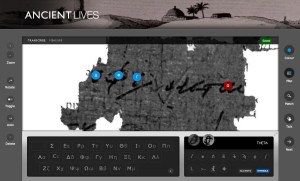
Annotating images: In order to have a good discussion about a lens candidate, we need to know which features we are talking about! We could do this by enabling you to put markers – like thumbtacks – on the images, during the classification stage. We think this would help a lot in the discussion, as each volunteer could indicate exactly what he/she is talking about. We could also then collect the coordinates of the objects in a database to make further analysis easier. A similar feature is already in use in Ancient lives.

-
Links to social networks: It was not much discussed, but it feels like this is necessary: new users might well find it fun to show off their new discoveries on facebook, etc, and this might then encourage more people to get involved. We’d like to find as many new LensHunters as we can!
- Volunteer achievements: At the moment, Galaxy Zoo users are labelled as newbies, heros and so on, according to their activity level on the forum. This is great – new users can see who has been there longest and is most active in helping others get started. Is there more feedback we could give users, that would improve their experience? Would you like to see your achievements logged in terms of the number of images you have inspected? Or the number of good lens candidates successfully detected? Or something else?
-
Zoonibot: Wikipedia has various “robots” that wander around its system, automatically making small corrections and suggestions. The Zoonibot is a first attempt at one of these robots for the Zooniverse Talk system. There are many things the Zoonibot could help with – such as pointing new users towards some of the reference and tutorial material on the site, if they seem sto be getting stuck. While we don’t want it to replace human interactions in the forum, it seems like the Zoonibot could be helpful in some situations. What do you think?
One more consensus came out of the workshop: it’s great if a zoo website *looks good.* There are some very talented designers working at the Zooniverse, who can help turn your ideas into reality. Keep them coming in the comments!
The first LensZoo project preview: beat the robots of the CFHT Legacy Survey!
Anupreeta More, Surhud More and Phil Marshall
Gravitational lensing is a spectacular phenomenon found in the Universe. Predicted by Fritz Zwicky in the 1930’s, galaxies and clusters of galaxies acting as lenses are not just beautiful to look at but they also have plethora of applications, including revealing the whereabouts of the elusive Dark Matter. Gravitational lenses are rare objects since we require the foreground and background galaxies to be aligned on the sky to within a few thousandths of a degree.
Over the coming decade, larger and larger imaging surveys will map out ever wider and deeper regions of the Universe. This means we should be able to find more gravitational lenses, but it also means that we will have increasing amounts of data to inspect in order to find them. As a result, we would like to automate the process of finding gravitational lens systems from these vast treasure troves of data. However, as you know, discovering gravitational lens systems requires some skill, and the lens candidates need to satisfy a varied set of criteria before they can be tagged as promising lens systems. Our brains are more suited to carry out such tasks than are simple computer algorithms, so it makes sense for humans to look at the candidates that the robots flag as interesting. However, so far, astronomers have had difficulties in building robots that are capable of finding all the different kinds of lens systems that are potentially interesting. This is partly because we have not yet discovered very many lenses, nor exhaustively cataloged all the things that look like lenses but are not lenses in reality. To understand how to make the robots work better, we need to jump in to the data alongside them!
Our first project in the Lens Zoo is going to be a slightly unusual one, in that it’s focus will be on beating a lens finding robot, rather than checking through its outputs. We are going to use the optical and infrared data from the Canada-France-Hawaii Telescope Legacy Survey (CFHTLS) for this project. With the help of computer algorithms called “ArcFinder” and “RingFinder”, we have found a sample of lens candidates from the CFHTLS – but we know that these algorithms don’t do a very complete job. Opportunity knocks! We would like the citizen scientists of the Lens Zoo to help us search the images of the CFHTLS to discover a variety of lenses which were missed by our robots.
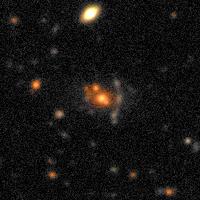
The CFHTLS spans an area of about 170 square degrees of sky. It’s images are both higher resolution than those of the SDSS, with median seeing in the i’ band of around 0.7 arcsec, and deeper (i’ < 24.5 magnitudes) – which means that more gravitational lenses should be visible per square degree. The picture on the left shows a lens from CFHTLS that the ArcFinder did spot, a small galaxy group that is lensing a background star-forming blue galaxy. On the right is the SDSS image of this system, to show you the difference in image quality.

We have two goals for this project. First, we want to find all the gravitational lenses that the aforementioned algorithms missed – perhaps because the sources are quasars, or distant red galaxies, or because the lenses are complex, or confusing. Second, we want to catalog all the objects that look like lenses, but are not: these “false positives” will make an important training set for us to test our improved robots on. This will be the first time that this survey’s images will have been exhaustively inspected – so there are bound to be some surprises!
A Postcard from Zurich
 Zurich: home to Albert Einstein when he first started thinking about light passing through warped spacetime, and so what better place to have our first workshop! The Lens Zoo team and a few Galaxy Zoo forum moderators and Lens Hunters met up at the Institute of Theoretical Physics at the University of Zurich at the weekend, both in person, and remotely via a Google+ video Hangout. Even the team from Chicago who got up at 3am to be projected four feet high onto a screen managed to stay cheerful the whole time! We spent a couple of days thinking through the problems that we’ll face when trying to find thousands of gravitational lenses over the next few years.
So, what did we talk about all weekend? Among other things: how we should display images, and how we can best enable their investigation, how to teach new users about gravitational lensing, which features of the various Zooniverse projects we could make use of, and what tools we have to help advanced Lens Hunters to go the extra mile. For now, you can see the slides that the science team made for some of the sessions in the links below. We’ve got a bunch of problems to solve, but also some good ideas to get started with. The team will be writing their own postcards from Zurich on here soon, and we look forward to hearing your comments as we go. We need and value your input!
PDF files of session slides (watch out, these are quite large files!):
Zurich_2012-07-14_Session-1_Aprajita_GZlenses
Zurich_2012-07-14_Session-2_Phil_Targets+Surveys
Zurich_2012-07-14_Session-3_Anupreeta_CFHTLS
Gravitational Lenses – Oxford, April 2012
Gravitational Lenses: Talk given at the Oxford Zooite Meet-up, April 2012
After giving this short talk, I made a video of it for all of you out there on the webs. I wanted to show some of ways we are using gravitational lenses in astrophysics research, and say something about how we might find more lenses to extend these investigations. That’s where the Lens Zoo comes in!
Phil
Designing the Lens Zoo: Have your say!
What features should the Lens Zoo website have, to help us find as many lenses as possible? We are planning a workshop in mid-July to discuss the interface and tools for the new Zoo, and to give us something to talk about, we’d love to hear from all you lens-hunters out there. We’ve setup a web form for you to send us any ideas about functionality or tools that you think would be useful in finding lenses. Here’s the address in full:
We’ll go through all your ideas when we meet up in Zurich, and keep you posted!
Stay tuned, and thanks for your help.
Phil, Aprajita & the Lens Zoo team
Lens Zoo is Coming…
We’re very pleased to tell you that we’ve been awarded developer time from the Citizen Science Alliance to build a new, exciting Zooniverse project to discover gravitational lenses.
What’s a gravitational lens, you might ask? When a massive galaxy or cluster of galaxies lies right in front of a more distant galaxy, the light from the background source gets deflected and focused towards us. These space-bending massive galaxies allow us to peer into the distant Universe at around 10x magnification, and to make accurate measurements of the total (dark and luminous) mass of galaxies.
As many of you know, there has been a long-running and enthusiastic search for lenses in the “weird and wonderful” part of the forum; although lens-finding was never a goal of the Galaxy Zoo project, this forum has turned up some interesting systems which we are still following up. Up until now, the GZ lens search has been quite informal: it has not been easy keeping track of all the candidates that have been suggested! Nevertheless, the Lens Hunters have done an amazing job, collecting and filtering the suggestions as they come in, and teaching themselves and each other about the astrophysics of lensing.
Impressive stuff: enough to persuade a group of professional astronomers that a specially-designed Zoo for identifying lenses could be a powerful way of analyzing the new wide-field imaging surveys that are coming online. In this Lens Zoo we will be able to provide you with new tools – designed, we hope, with you – to find new lenses more effectively. We have teamed up with astronomers from several big surveys who are eager to harness your citizen science power, and will be providing a lot of new, high quality data to be inspected. Over the next 6-10 months we’ll be working hard with the Zooniverse developers to build the Lens Zoo, and we hope you will join us for the ride: Lens Zoo needs you!
Phil, Aprajita, Anupreeta & the Lens Zoo team.
 Space Warps