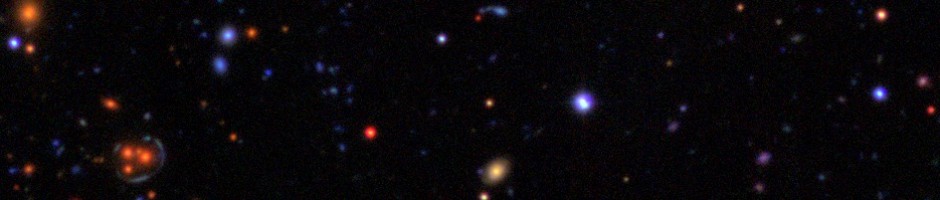
Rare strong lens gems emerging from the Space Warps ESA Euclid Data Release 1 search
A few months ago, we started the full-scale search for strong gravitational lenses in the ESA Euclid Data Release 1 (DR1) survey. While we are carefully analysing your classifications, in this blog post we highlight some of our favourite strong lens candidates that you’ve collectively found in this dataset.
Congratulations!! You’ve now passed the milestone of an incredible 5 million classifications since the first ESA Euclid Quick Data Release 1 (Q1) lens search began in 2024, including 2.7 million in the current ESA Euclid DR1 search. We have been completely blown away, and are excitedly analysing all your classifications! While the lens search and our analysis continue, we wanted to highlight some of the stunning strong lens candidates that you have found and let you know what’s happening next with the lens search.
Beyond the fascinating individual systems we highlight in this blog post, thousands of other lens candidates are emerging from your collective classifications – such a large population which will help to revolutionise the study of strong lenses. Prior to Euclid DR1 only a few hundred strong gravitational lenses had been identified in space-based imaging and so the thousands of lens systems which you have found will change how we can study these systems, enabling us to analyse the strong lens population as a whole.
Amongst this treasure trove of lens systems are some scientific gems:
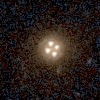
First up is a lensed quasar (ID: 119727051); this has four lensed images forming a ‘quad’ configuration. The light from the quasar (a bright supermassive black-hole at the centre of a distant galaxy) is strong enough to outshine both the light of the deflector or lens galaxy and that of the host galaxy it resides in. Unlike galaxy-galaxy strong lenses, the light from the central deflector can’t be seen in the image. Quasars, in particular quadruply imaged quasars like this one, are particularly useful probes of cosmology. Light emitted from the background quasar will arrive at the Earth at different times depending on which of the four routes (corresponding to the 4 lensed images) that it takes. The arrival time of the emitted light is dependent on the degree of lensing (how much mass there is in the deflector galaxy), and the expansion rate of the universe. From the separation of the lensed images we can estimate the mass of the deflector or lens and therefore, by measuring the time delay of each of the four images, strongly lensed quasars can help to constrain the expansion of the universe!
Next up are two lens systems with bright dust lanes (119696543 and 119705025 ). In both of these systems, at least 3 lensed images are visible (in the left example the counter-image is likely hidden behind the smaller satellite galaxy to the right). These systems highlight the superb resolution of the Euclid telescope, as well as the benefits of colour imaging which helps distinguish the dust lanes from lensed arcs or tidal features.
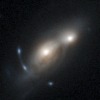
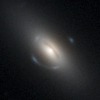
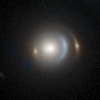
This is an example of a candidate double-source-plane lens (ID: 119665581) – here the deflector galaxy is lensing two different background galaxies, creating two sets of lensed arcs. These are very rare systems even within strongly lensed systems since they require the close alignment of two source galaxies with the deflector galaxy rather than just one. They are also especially useful for a range of astrophysical and cosmological studies, for example the two Einstein rings allow us to tightly constrain how much mass is present in the deflector galaxy, and where it is most concentrated.
This final system (ID: 121188143) suggests that the lensed background galaxy has interesting structure. In this image you can see four images of the same bright, white blob but around these finer stellar filaments can be seen. This implies that the background galaxy has a central bright component and more extended fainter structure around it. By developing a model of such systems, we can remove the distortion caused by gravitational lensing and reconstruct what the source galaxy really looks like. The extra detail visible in the lensed arcs can help us produce a sharper, higher-resolution image of the background galaxy than would be possible if we were observing the same galaxy without the amplification and magnification by strong lensing.
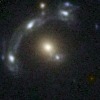
These systems are just a small snapshot of the lensed systems you have already identified. Behind the scenes, we are analysing all of your classifications both in classify and refine in preparation for the public release of all the Euclid DR1 images in November this year. In the meantime, we are adding the second batch of approximately 50,000 Euclid DR1 images to Space Warps Classify. These systems were flagged as lens candidates by a new machine learning network, and we’re keen to see what you think! This network used multiple bands (colours) in order to classify the lensed images, so it will be really interesting to see if different types of strong lens systems appear in this second batch compared to the first.
Thank you again for your classifications and we look forward to discussing further exciting strong lens systems with you!
The Space Warps ESA Euclid Strong Lens team.
WOW: A million classifications!!
After just two weeks, we have surpassed an incredible 1 million classifications on the new ESA Euclid data! Many congratulations to all of the Space community on reaching this milestone! We have been blown away by your amazing contributions – a huge thank you to each and every one of you! In this blog post, Phil Holloway shares some of his favourites from the fantastic systems the Space Warps community has found so far.
First up is a double-source plane lens (ID: 119647449), where two different galaxies, at different distances from us, are lensed by the same foreground galaxy. Double-source plane systems are very rare because they require all three galaxies (the lens, and two sources) to be almost perfectly aligned. This system shows two rings around the central lens, and is reminiscent of the Jackpot lens in its almost circular nature. Such a clear double-source-plane lens will no doubt be studied for many years to come.
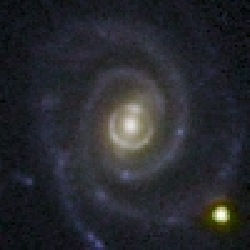
The second system is a face-on spiral lens (ID: 119679277). Most lens galaxies are elliptical and are typically made up of old stars. Occasionally, spiral galaxies can act as lenses, since they have the most massive and older stars in their central regions, though when they do they are usually seen edge-on since this maximises the amount of mass along our line-of-sight which makes lensing more likely. Face-on spiral lenses, such as shown below, are practically unheard of! This lens, alongside a beautiful spiral galaxy complete with bright blue star-forming clumps, is a really fantastic find.
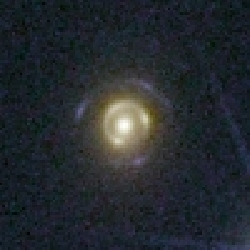
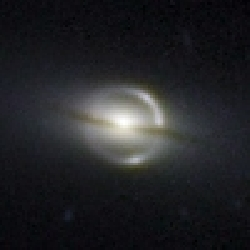
Finally, we have an edge-on lens surrounded by a near-complete Einstein ring (ID: 119674016). There are two darker lines extending horizontally along the length of the lens – this is dust within the lens galaxy, which acts to absorb some of the background light. The light of the source galaxy is relatively white/yellow, which indicates it could be made up of older stars, have dust that turns blue light red or be very distant (further analysis is needed to identify which it is), unlike many lensed sources which appear blue because of their young stellar population.
These amazing finds are just a small fraction of the lenses you’ve discovered so far and we can’t wait to see what else you’ll find. Thanks again for all your amazing classifications, happy classifying and we’ll see you on Talk!
Space Warps helps to find 497 spectacular lenses in Euclid data
by Phil Holloway
Thanks to your incredible efforts, we are delighted to have found 497 strong lens candidates in Euclid Q1 data. Over the course of the project we had more than 800,000 classifications from over 1000 wonderful volunteers, and the results are a testament to your hard work. As part of the lens search, we developed the Strong Lens Discovery Engine, a pipeline to search for lenses in Euclid data, of which Space Warps was an integral part.
We found a whole range of lens candidates – a collage of our favourites is below, with a whole range of lens configurations. We also found 4 double-source-plane lenses! These are incredibly rare systems where the lensing galaxy deflects light from two different background galaxies, forming double rings/arcs.
We have temporarily removed these images while the Euclid Refine project is live
Credit: ESA/Euclid/Euclid Consortium/NASA, M. Walmsley, T. Li, N. Lines, and Euclid SL SWG
We have temporarily removed these images while the Euclid Refine project is live
Credit: Euclid Collaboration: Walmsley et al (2025)
As part of the Strong Lens Discovery Engine we used multiple machine learning algorithms (including ‘Zoobot’ trained using zooniverse classifications in Galaxy Zoo) to do an initial sift of the data which the Space Warps volunteers inspected to find the most likely lens candidates. This machine + volunteer partnership will be crucial with the much larger data releases coming soon from the Euclid survey. We also used Euclid’s incredible resolution to produce precise models of all the lens candidates and will continue to analyse these fascinating lenses for many months and years to come!
You can read the full results in the 5 science papers released today:
B: Lens search around massive galaxies,
C: Finding lenses with machine learning,
D: Double-source-plane lenses,
E: Lens classification combining machine learning and Space Warps.
Thank you again for your incredible hard work in finding these amazing lenses – we couldn’t have done it without you! Keep an eye out for future Space Warps projects – this initial data release was only 0.4% of the sky area of the full survey, so there will be many many more exciting lenses to find soon!
Stay tuned!
Phil and the Space Warps Team
Phil Holloway is a final year PhD student in the Department of Physics at Oxford and has done amazing work through his time with us including on Space Warps! We’re so thankful to Phil and to you all for making these results possible. Phil, Anu & Aprajita (Space Warps co-leads).

