Rare strong lens gems emerging from the Space Warps ESA Euclid Data Release 1 search
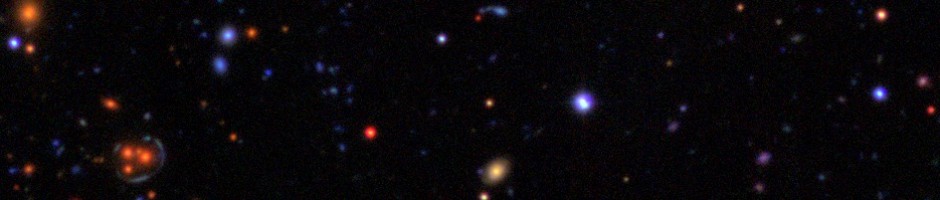
A few months ago, we started the full-scale search for strong gravitational lenses in the ESA Euclid Data Release 1 (DR1) survey. While we are carefully analysing your classifications, in this blog post we highlight some of our favourite strong lens candidates that you’ve collectively found in this dataset.
Congratulations!! You’ve now passed the milestone of an incredible 5 million classifications since the first ESA Euclid Quick Data Release 1 (Q1) lens search began in 2024, including 2.7 million in the current ESA Euclid DR1 search. We have been completely blown away, and are excitedly analysing all your classifications! While the lens search and our analysis continue, we wanted to highlight some of the stunning strong lens candidates that you have found and let you know what’s happening next with the lens search.
Beyond the fascinating individual systems we highlight in this blog post, thousands of other lens candidates are emerging from your collective classifications – such a large population which will help to revolutionise the study of strong lenses. Prior to Euclid DR1 only a few hundred strong gravitational lenses had been identified in space-based imaging and so the thousands of lens systems which you have found will change how we can study these systems, enabling us to analyse the strong lens population as a whole.
Amongst this treasure trove of lens systems are some scientific gems:
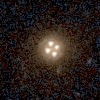
First up is a lensed quasar (ID: 119727051); this has four lensed images forming a ‘quad’ configuration. The light from the quasar (a bright supermassive black-hole at the centre of a distant galaxy) is strong enough to outshine both the light of the deflector or lens galaxy and that of the host galaxy it resides in. Unlike galaxy-galaxy strong lenses, the light from the central deflector can’t be seen in the image. Quasars, in particular quadruply imaged quasars like this one, are particularly useful probes of cosmology. Light emitted from the background quasar will arrive at the Earth at different times depending on which of the four routes (corresponding to the 4 lensed images) that it takes. The arrival time of the emitted light is dependent on the degree of lensing (how much mass there is in the deflector galaxy), and the expansion rate of the universe. From the separation of the lensed images we can estimate the mass of the deflector or lens and therefore, by measuring the time delay of each of the four images, strongly lensed quasars can help to constrain the expansion of the universe!
Next up are two lens systems with bright dust lanes (119696543 and 119705025 ). In both of these systems, at least 3 lensed images are visible (in the left example the counter-image is likely hidden behind the smaller satellite galaxy to the right). These systems highlight the superb resolution of the Euclid telescope, as well as the benefits of colour imaging which helps distinguish the dust lanes from lensed arcs or tidal features.
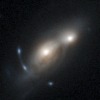
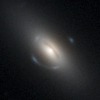
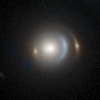
This is an example of a candidate double-source-plane lens (ID: 119665581) – here the deflector galaxy is lensing two different background galaxies, creating two sets of lensed arcs. These are very rare systems even within strongly lensed systems since they require the close alignment of two source galaxies with the deflector galaxy rather than just one. They are also especially useful for a range of astrophysical and cosmological studies, for example the two Einstein rings allow us to tightly constrain how much mass is present in the deflector galaxy, and where it is most concentrated.
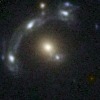
This final system (ID: 121188143) suggests that the lensed background galaxy has interesting structure. In this image you can see four images of the same bright, white blob but around these finer stellar filaments can be seen. This implies that the background galaxy has a central bright component and more extended fainter structure around it. By developing a model of such systems, we can remove the distortion caused by gravitational lensing and reconstruct what the source galaxy really looks like. The extra detail visible in the lensed arcs can help us produce a sharper, higher-resolution image of the background galaxy than would be possible if we were observing the same galaxy without the amplification and magnification by strong lensing.
These systems are just a small snapshot of the lensed systems you have already identified. Behind the scenes, we are analysing all of your classifications both in classify and refine in preparation for the public release of all the Euclid DR1 images in November this year. In the meantime, we are adding the second batch of approximately 50,000 Euclid DR1 images to Space Warps Classify. These systems were flagged as lens candidates by a new machine learning network, and we’re keen to see what you think! This network used multiple bands (colours) in order to classify the lensed images, so it will be really interesting to see if different types of strong lens systems appear in this second batch compared to the first.
Thank you again for your classifications and we look forward to discussing further exciting strong lens systems with you!
The Space Warps ESA Euclid Strong Lens team.

